

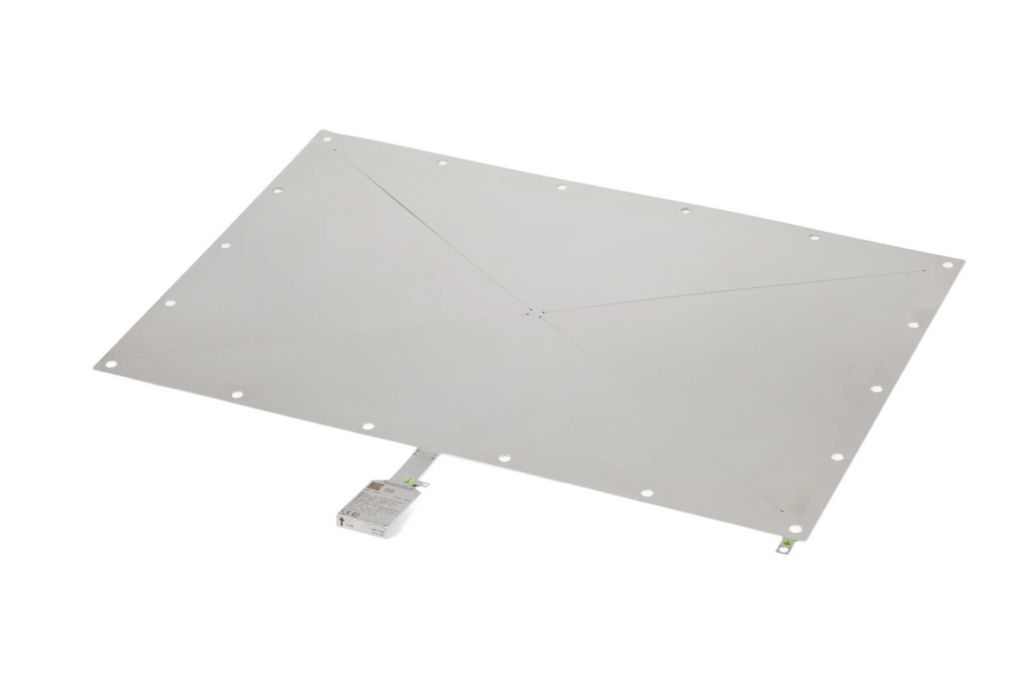
Industrial plant safety is never the result of a single solution — it depends on a coordinated system of devices that intervene at the right moment, in the right way. Explosion venting panels are among the most critical components of that system: engineered to open instantaneously during an internal explosion, they evacuate the excess pressure before the blast wave can damage structures, equipment, or personnel. This guide covers the operating principles, main types, sizing criteria, and application sectors, with reference to the relevant international standards.
Takeaway
- Explosion venting panels are calibrated passive devices that open at a predefined static activation pressure (p_stat), releasing energy and gases in a controlled manner during an explosive event.
- Correct sizing follows EN 14491 (for dust) and EN 14994 (for gas), which define the minimum vent area based on enclosure volume and material reactivity.
- Primary applications include silos for combustible dusts, bag filters, mixers, reactors, and ATEX-classified equipment in the chemical, food, pharmaceutical, and energy sectors.
What Are Explosion Venting Panels and Why Are They Critical for Explosion Protection
An explosion venting panel is a passive safety device — no moving parts, no electronic actuators — designed to open mechanically when a predefined pressure threshold is exceeded. Unlike a rupture disc, which protects pressurised systems (pipelines, reactors, pressure vessels) from process overpressures and maintains a hermetic seal until activation, explosion venting panels are specifically engineered to handle the dynamic pressures generated by an explosive event inside large-volume enclosures that are normally unpressurised during regular operation.
The underlying physical principle is straightforward. When ignition occurs inside a confined space containing combustible gas, vapour, or dust, internal pressure builds extremely rapidly. If not relieved within milliseconds, the explosion can cause structural collapse of the enclosure, with potentially catastrophic consequences. The venting panel interrupts this sequence by opening a calibrated relief surface: hot gases and flames are expelled in a controlled direction toward a safe area, reducing pressure to levels the structure can withstand.
Static Activation Pressure (p_stat) and Design Parameters
The central parameter of any explosion venting panel is the static activation pressure, commonly referred to as p_stat. It represents the minimum pressure at which the device begins to open, and must be calibrated precisely against two distinct constraints: the reduced explosion pressure the structure can sustain without damage (Pred), and the maximum deflagration pressure the specific flammable mixture can develop (Pmax). The correct balance between these values forms the basis of normative sizing, which also accounts for the Kst value (deflagration index for dust) and Kg value (deflagration index for gas).
A panel sized with p_stat too high would delay opening, allowing pressure to exceed structural limits. One with p_stat too low might activate under normal operating pressure fluctuations, causing unplanned openings and production interruptions. The calibration window is therefore narrow, requiring accurate technical analysis on a case-by-case basis.
How an Explosion Venting Panel Works During an Explosion
The activation cycle of an explosion venting panel unfolds in just a few milliseconds. When internal pressure reaches p_stat, the membrane or panel yields in a programmed manner, opening a surface through which gases expand outward. Depending on the design, the panel may open completely — detaching from the flange — or partially, through pre-engineered hinges or petals, directing the discharge flow toward a defined area established at the design stage.
This directional aspect is not secondary: the expelled flow carries high velocity and temperature, and must be directed toward areas free of personnel and sensitive equipment. In some plants, venting panels are installed with vent ducts to channel combustion gases toward building exits or safe discharge zones. In other contexts, particularly outdoors, venting can occur directly to atmosphere, provided no secondary ignition sources are present in the surrounding area.
Deflagration Panels vs. Detonation Scenarios
Not all explosions behave the same way. Industrial practice distinguishes between two main modes of flame propagation: deflagration, where the flame front travels at subsonic speed relative to the unburned mixture, and detonation, where the flame exceeds the speed of sound and generates shock waves of considerably higher intensity.
Standard venting panels, compliant with EN 14491 and EN 14994, are designed to manage deflagrations. This covers the vast majority of hazardous scenarios in industrial environments involving dusts and gases — silos, filters, dryers, mixers. For detonation-risk scenarios (typically applications involving highly reactive gases such as hydrogen or acetylene in specific chemical plants), different engineering approaches are required, often combined with explosion suppression systems or physical barriers.
Types of Explosion Venting Panels: Materials, Shapes and Configurations
Not all explosion venting panels are alike: the right configuration depends on the geometry of the equipment to be protected, operating conditions, reactivity of the explosive mixture, and installation constraints.
Aluminium and Stainless Steel Panels
The most common construction materials are aluminium (preferred for medium-to-low pressure applications and where minimising device weight matters) and stainless steel (for chemically aggressive environments, high temperatures, or hygienic applications in the pharmaceutical and food industries). In both cases, sheet thickness is the determining factor: combined with the geometry of pre-scored lines or engineered break points, it defines the p_stat value within the tolerance required by the applicable standard.
Panels are also available in composite materials or with PTFE linings for particularly corrosive environments, or in multi-layer configurations to achieve greater mechanical resistance while still maintaining a low and controlled activation pressure.
Panel Shapes and Vent Areas
Geometrically, explosion venting panels can be rectangular, circular, or custom-shaped, to fit available openings on silos, filters, buildings, or vessels. The effective vent area (Av) must result from the normative calculation: it indicates how much surface must be able to open so that the reduced explosion pressure remains below Pred. Insufficient vent area compromises protection effectiveness; oversized areas can create structural problems in the enclosure or installation difficulties.
Reference Standards for Sizing: EN 14491 and EN 14994.
Two international standards govern the sizing of explosion venting panels in industrial settings, and understanding them is essential to designing effective, compliant explosion protection.
EN 14491 is the European standard specifically covering protection from dust explosions by venting. Complementary to the ATEX regulatory framework, it defines sizing requirements for explosion vents on silos, filters, dryers and similar equipment, and is the most relevant norm for plants within the European Economic Area.
EN 14994 is the European standard specifically covering protection from gas explosions by venting. Complementary to the ATEX regulatory framework, it defines sizing requirements for explosion vents on silos, filters, dryers and similar equipment, and is the most relevant norm for plants within the European Economic Area.
Main Applications of Explosion Venting Panels
Silos and Combustible Dust Processing Equipment
The most widespread application is undoubtedly the protection of silos and equipment handling combustible dusts: flour, sugar, sawdust, coal, plastics, animal feed, metal powders. In these environments, dust clouds suspended in air form potentially highly reactive explosive mixtures. An accidental ignition source — a spark, a hot surface, an electrostatic discharge — can trigger a deflagration within seconds, and without an adequate venting system, the silo or filter will fail structurally. Venting panels, installed on the roof or sides of the enclosure, manage this scenario by reducing overpressure to levels compatible with the structure.
Bag Filters and Cyclone Separators
In bag filters, dust accumulation on filter fabrics can reach explosive concentrations during pulse-jet cleaning cycles. The internal volume of a filter is relatively small compared to a silo, but the pressure generated by a deflagration can still be sufficient to destroy the casing. Venting panels are applied to filter surfaces in quantities and dimensions calculated based on internal volume and dust type. Some plants combine venting with chemical suppression systems to also protect downstream ducting, where the flame could propagate.
Chemical, Pharmaceutical and Energy Plants
In chemical and petrochemical plants, explosion venting panels find application on spray dryers, high-speed mixers, fluidised bed reactors and similar equipment processing solvents, active pharmaceutical ingredients, or potentially flammable reaction intermediates. In these environments, hygienic requirements may dictate specific materials and designs allowing rapid panel cleaning or replacement. In the pharmaceutical sector, the same considerations apply to dryers and granulators, where active powder can be highly flammable. In biogas and biomass plants, venting panels protect gasholders, digesters, and gas treatment units from abnormal overpressures linked to unexpected production variations or system failures.
Selection Criteria and Installation Aspects Not to Overlook
Choosing an explosion venting panel does not end with calculating the vent area. Several practical factors affect both the device’s effectiveness and its compatibility with the existing plant.
The discharge direction is the first element to establish: the flow must be oriented toward safe areas, free from personnel and sensitive equipment, and preferably toward the outside of the building. When indoor venting is unavoidable, properly sized vent ducts must be provided (ducts introduce flow resistance and reduce venting effectiveness, and must therefore be included in the calculation).
The operating pressure of the plant is another critical constraint. In certain processes, enclosures operate at slightly positive or negative pressures relative to atmosphere; the panel must withstand these conditions without unintended activation, while still opening reliably at p_stat. Panels with additional retention systems (vacuum support) allow p_stat to remain low even under negative operating pressures.
Finally, inspection and replacement frequency: explosion venting panels are single-use devices. Once opened by an explosive event, they cannot be reused and must be replaced before returning the equipment to service. This applies even in cases of partial or unintended opening. Installation design must account for this requirement, ensuring adequate access and replacement times compatible with production needs.
DonadonSDD Explosion Venting Panels: Custom Engineering for Every Plant
DonadonSDD, now part of the Baker Hughes group, designs and manufactures explosion venting panels fully customised to the specific conditions of each individual plant: activation pressure, geometry, materials, dimensions, and regulatory requirements. Production takes place at the Corbetta (Milan) facility, with rigorous quality control on every device. The panel range integrates with the full product portfolio — including rupture discs and rupture indicators — to provide complete overpressure protection for process plants. For technical enquiries or sizing requests, contact the DonadonSDD team.
FAQ
A rupture disc is designed to protect pressurised systems (pipelines, reactors, pressure vessels) from process overpressures and maintains a hermetic seal until activation. An explosion venting panel is sized to manage the dynamic pressure generated by an explosion inside large-volume enclosures that are normally unpressurised — such as silos, filters, or dryers. The two devices address distinct risks and in many plants they coexist, performing complementary functions.
Yes. Explosion venting panels are single-use devices: once opened by an explosive event, a panel cannot be reused and must be replaced before the equipment is returned to service. This applies even if the opening was partial or unintended. Maintaining an adequate stock of replacement panels is therefore an integral part of any safety maintenance plan.
Yes, but with specific precautions. When venting cannot occur directly to the outside, vent ducts must be designed to channel combustion gases toward a safe exit point. Duct runs introduce additional flow resistance that must be included in the vent area calculation — typically resulting in a larger required area. Alternatively, in certain contexts, venting can be combined with flameless explosion suppression systems that eliminate the need for an outdoor discharge path.