

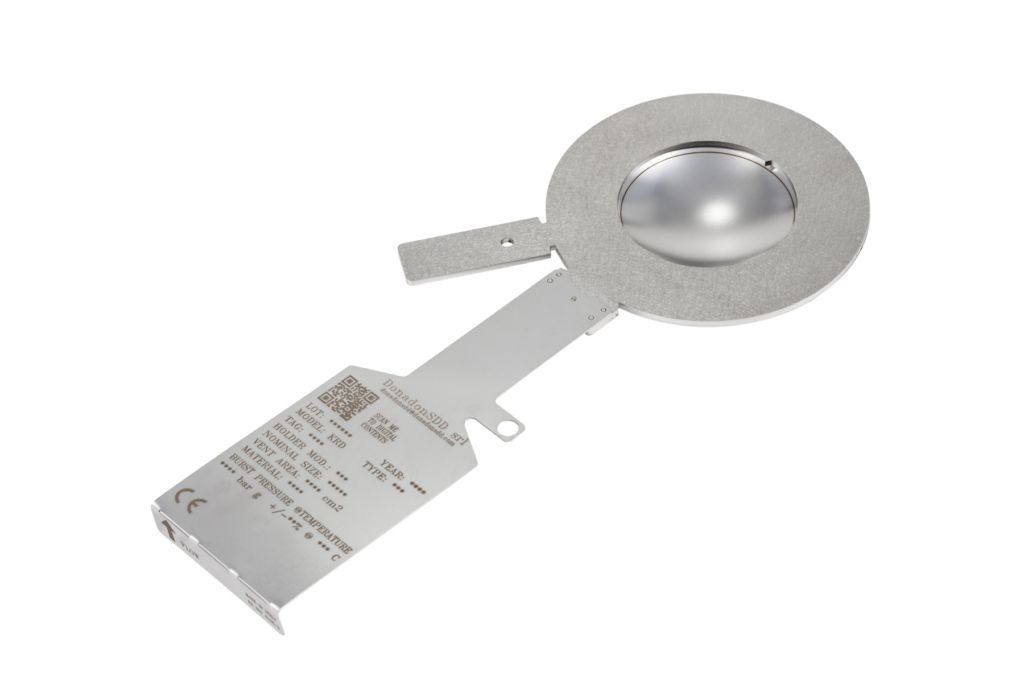
Rupture discs are critical pressure relief devices designed to protect industrial plants and pressurized systems from overpressure scenarios. In this in-depth guide, we explain what rupture discs are, how they work, the main types available and the industrial sectors where they are commonly used. The content is intended for engineers and process safety professionals who need a clear, reliable and comprehensive technical overview.
Takeaway
- Rupture discs are passive pressure relief devices designed to protect systems from critical overpressure
- Several types are available, including forward-acting and reverse-buckling rupture discs, each suitable for specific process conditions
- Proper selection and customization are essential to ensure safety, regulatory compliance and operational continuity
What rupture discs are and why they are essential overpressure safety devices
A rupture disc is a thin metallic or composite membrane pressure relief device designed to rupture in a controlled manner when the internal pressure of a pressurized system exceeds a predetermined burst pressure. This causes the immediate opening of the system and the rapid release of excess pressure, preventing damage to personnel, equipment and the surrounding environment.
Unlike other overpressure protection devices, such as safety relief valves, rupture discs have no moving parts and do not require active intervention. As a result, they are considered extremely reliable, since they eliminate the risk of mechanical sticking, clogging or malfunctions caused by wear.
For this reason, rupture discs are often used either as primary pressure relief devices or as a backup system in combination with other overpressure safety solutions.
How a rupture disc works
The operation of a rupture disc is based on a simple but highly precise principle. Each rupture disc is engineered and calibrated to rupture at a predetermined burst pressure, defined during the design and manufacturing process. When the internal pressure exceeds this value, the membrane ruptures instantaneously.
This results in three immediate effects:
- full opening of the flow area
- rapid and controlled discharge of the process fluid
- reduction of system pressure below the critical threshold
Because rupture discs are non-reclosing devices, they must be replaced after activation.
However, this characteristic guarantees a very high level of safety, as there are no partial openings or delayed responses.
Main types of rupture discs
Not all rupture discs are the same. Selecting the correct type depends on operating conditions, process fluid characteristics and applicable regulatory requirements.
Forward-acting rupture discs
In forward-acting rupture discs, pressure is applied to the convex side of the membrane, which progressively deforms until rupture occurs.
This design is structurally simple and widely used, but it can be more sensitive to fatigue phenomena, particularly in applications characterized by frequent pressure cycling or variable operating conditions.
Reverse-buckling rupture discs
In reverse-buckling rupture discs, pressure is applied to the concave side of the disc, generating a controlled buckling mechanism that leads to rupture.
This design offers higher resistance to fatigue, greater accuracy of the burst pressure and longer service life. For these reasons, reverse-buckling rupture discs are often preferred for critical applications or processes with high cyclic loads.
Graphite rupture discs and special materials
In highly aggressive chemical or thermal environments, rupture discs made of graphite or special metal alloys are commonly used. Graphite rupture discs, in particular, provide excellent corrosion resistance, making them especially suitable for chemical process applications.
Rupture disc applications across industrial sectors
Rupture discs are used in a wide range of industrial sectors wherever protection against potentially dangerous overpressure is required.
In the chemical and petrochemical industries, rupture discs protect reactors, columns, heat exchangers and storage vessels.
In pharmaceutical and food processing plants, they are valued for their reliability and their ability to meet strict hygiene and process safety standards.
In the energy and power generation sector, rupture discs play a key role in protecting boilers, pressurized circuits and high-temperature systems. They are also widely used in advanced manufacturing environments as a core element of overpressure safety strategies.
Rupture discs as overpressure safety devices
From both a regulatory and engineering perspective, rupture discs are fully recognized as overpressure safety devices. Their function is to prevent pressure from exceeding the design limits of pressurized equipment, reducing the risk of explosions or structural failures.
As a result, rupture disc selection cannot be fully standardized. Parameters such as burst pressure, operating temperature, chemical compatibility, manufacturing tolerances and installation configuration must be carefully evaluated on a case-by-case basis.
The importance of customization and manufacturer expertise
In complex industrial environments, safety depends not only on the product itself, but also on the expertise behind its design and manufacturing. The ability to develop custom rupture discs allows the device to be precisely matched to real process operating conditions, significantly improving safety and reliability.
DonadonSDD’s experience as a specialized Italian manufacturer represents a concrete advantage for companies and engineers seeking reliable, customized rupture disc solutions that comply with European and international standards. Deep knowledge of industrial processes enables technical support not only in supplying the component, but also in identifying the most appropriate engineering solution.
FAQ about rupture discs
A rupture disc is required when system design or process safety evaluations identify overpressure scenarios that cannot be safely managed by other devices, or when regulations explicitly require its installation.
The choice depends on the application. In many systems, rupture discs and safety valves are used together, as they provide complementary overpressure protection.
A rupture disc must be replaced after every activation and, in some cases, preventively if operating conditions may affect its performance.