

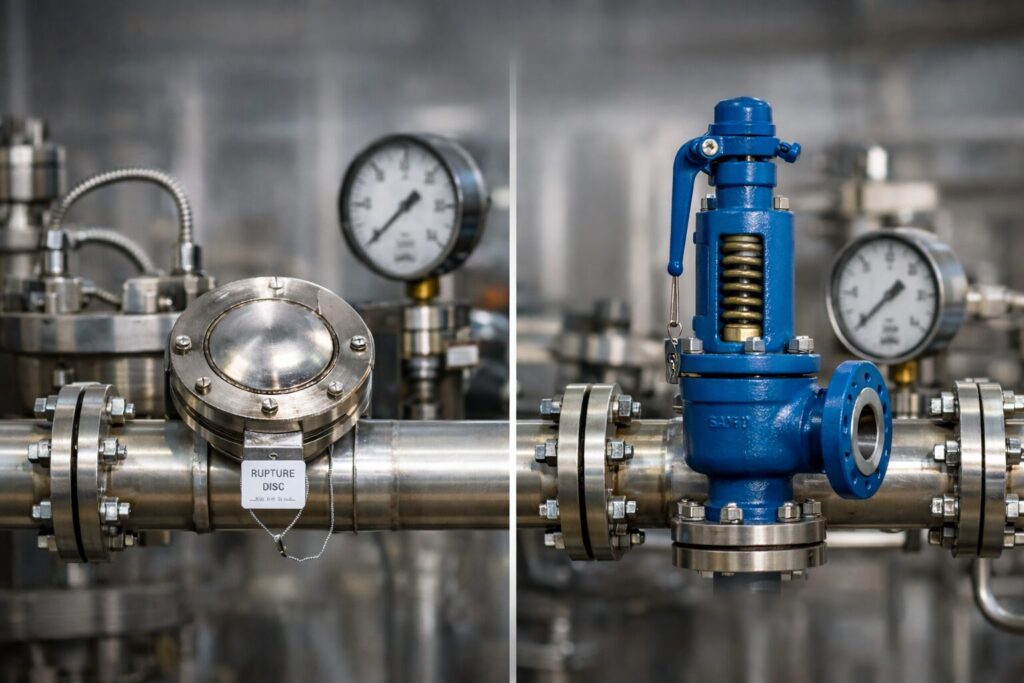
When it comes to overpressure protection in industrial systems, the comparison between safety valves and rupture discs is inevitable. Both devices protect personnel, equipment and production processes, yet they operate in fundamentally different ways. Understanding these differences means making an informed choice, avoiding unnecessary costs or, worse, underestimating operational risk.ve technical overview.
Takeaway
- A rupture disc provides full leak-tight sealing, operates only once and guarantees zero leakage until activation.
- A safety valve is reusable, but requires periodic maintenance and has a higher initial investment cost.
- In many critical plants, a combined configuration offers the most comprehensive and efficient protection.
Safety Valve vs Rupture Disc: How They Really Work
The main difference between a safety valve and a rupture disc lies in their activation principle.
A safety valve is a mechanical device calibrated to a specific set pressure. When system pressure exceeds the preset value, the valve opens progressively, releases excess fluid, and once normal conditions are restored, it recloses. This allows reuse and operational continuity without replacing the component.
A rupture disc, on the other hand, is a calibrated membrane that bursts instantaneously when the burst pressure is reached. The action is sharp, immediate and irreversible. Once activated, the disc must be replaced.
This is the first true decision criterion: controlled and reusable modulation, or instantaneous and definitive intervention?
Leak Tightness and Emissions: An Often Overlooked Factor
The operation of a rupture disc is based on a simple but highly precise principle. Each rupture disc is In many chemical or pharmaceutical plants, sealing performance makes a real difference.
By design, a rupture disc ensures zero leakage until activation. There is no weeping, no evaporation of hazardous or costly fluids. This is crucial when handling toxic gases, corrosive media or controlled atmospheres.
A safety valve, although designed to provide tight shutoff, may over time develop micro-leakage due to seat wear or fluid contamination. Therefore, it requires scheduled inspection and maintenance.
In high-purity systems, this distinction is not theoretical. It is operational.
Advantages and Limitations: Choosing Based on Application Context
There is no universal answer to the question: “Is a safety valve better than a rupture disc?” The correct approach starts from process conditions, fluid characteristics and risk assessment.
Advantages of a Rupture Disc
- Typically lower initial cost compared to a safety valve in standard applications, enabling optimized capital expenditure especially in plants with multiple protection points.
- Extremely fast response time, bursting within milliseconds, managing pressure spikes without mechanical lag.
- Perfect leak-tight sealing until activation, even with light gases or highly volatile fluids.
- No moving parts, therefore no springs, seats or guides subject to progressive wear, ensuring highly predictable performance over time.
Main limitation: single-use device. After activation, the plant must be shut down to replace the disc, investigate root causes and fully restore operations. In continuous processes, downtime can significantly impact operating costs and production schedules.
Advantages of a Safety Valve
- Reusable device. After relieving pressure, the valve can automatically reseat and resume operation if no damage occurred, minimizing downtime in non-critical events.
- Modulated and controlled discharge. Opening is proportional to excess pressure, reducing mechanical shock and maintaining system stability.
- Ideal for recurring or temporary overpressure events in dynamic production environments.
Main limitation: higher initial investment and need for periodic maintenance. Regular inspections, recalibration and internal component checks are required. Improper maintenance may compromise set pressure accuracy and reliability.
In continuous manufacturing plants, reusability may represent a mid-term economic advantage. However, in contamination-sensitive processes, rupture discs are often preferred.
Ultimately, the choice depends on operational priorities.
Combined Use: The Optimal Solution for Critical Systems
In complex industrial environments, the comparison between safety valves and rupture discs does not end with an either-or decision. Often, the answer is both.
Installing a rupture disc upstream of a safety valve is not simple redundancy, but an advanced engineering solution that separates sealing function from pressure regulation.
This configuration offers concrete advantages:
- Protection of the safety valve from corrosive or contaminating fluids.
- Full leak-tight isolation of the valve until activation.
- Reduced maintenance and extended valve service life.
- Improved set pressure accuracy and long-term reliability.
From both economic and operational perspectives, a combined system balances capital expenditure, maintenance cost and operational risk. In high-value production environments, this solution often proves the most sustainable over the long term.
In chemical, petrochemical, pharmaceutical and energy sectors, this configuration frequently represents the safest engineering standard.
How to Select the Right Device: A Consultative Engineering Approach
For process engineers in manufacturing industries, selection should never be driven by unit price alone. It must result from an integrated technical and economic evaluation considering lifecycle sustainability and operational continuity.
Key factors include:
- Fluid characteristics: corrosiveness, toxicity, viscosity, particulate content.
- Frequency and severity of overpressure events.
- Requirement for absolute leak tightness.
- Cost of plant downtime and restart procedures.
- Maintenance strategy and regulatory compliance requirements such as PED and international standards.
Additional management-level considerations include residual risk assessment, plant safety policies and alignment with corporate HSE frameworks.
An incorrect selection may impact not only operational costs but also personnel safety, corporate reputation and overall process resilience.
At DonadonSDD, we support engineers and technical managers in application analysis, evaluating not only burst or set pressure, but the entire operational context of the plant. This approach ensures protection systems aligned with both safety and productivity goals.
Key Points for an Informed Decision
If the objective is maximum sealing integrity and zero leakage risk, a rupture disc offers a structural advantage.
If operational continuity with repeated interventions is the priority, a safety valve provides greater flexibility.
When the process is critical, a combined configuration ensures the most comprehensive protection.
FAQ
A safety valve opens and recloses automatically, while a rupture disc bursts once and must be replaced.
Generally yes in terms of initial cost, but replacement costs after activation must be considered.
Yes. Series installation is a common engineering practice to enhance safety, leak tightness and system durability.