
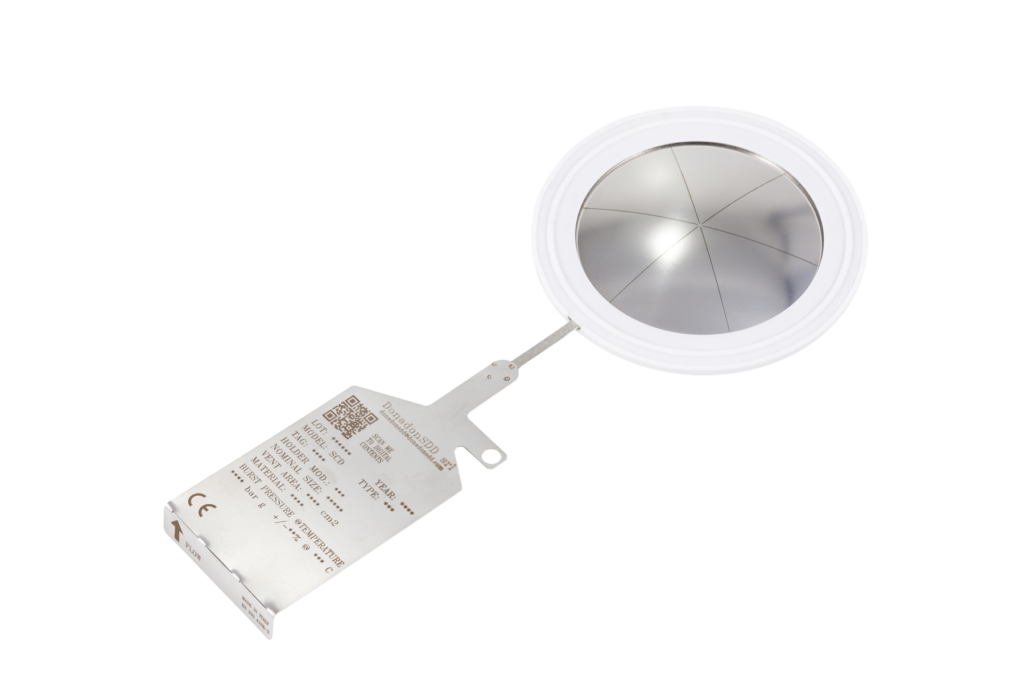
In a chemical or pharmaceutical plant, a rupture disc is not a simple accessory component. It is a primary safety device that must operate with absolute precision when pressure exceeds the design limit, protecting reactors, process lines and personnel.
Its selection directly affects safety, production continuity and regulatory compliance. In this guide, we analyze the technical criteria for properly selecting rupture discs for the chemical industry, with a specific focus on material compatibility, sterility requirements and certifications required in the pharmaceutical sector.
Takeaway
- Rupture disc selection starts from pressure, temperature and the nature of the process fluid.
- In pharmaceutical environments, sterility, surface roughness and FDA or USP certifications for product-contact parts are mandatory requirements.
- Custom solutions, such as sanitary CIP/SIP rupture discs, reduce contamination risk and plant downtime.
Technical criteria for selecting a rupture disc in chemical and pharmaceutical applications
Selecting a rupture disc for chemical and pharmaceutical plants requires a structured and multidimensional technical analysis. It is not simply about choosing a pressure value, but about identifying the device that guarantees reliable activation, chemical compatibility and long-term production continuity.
The correct choice results from the integrated analysis of five key parameters, strictly interconnected and linked to the actual operating conditions of the plant.
Burst Pressure and Operating Tolerances
The burst pressure value must be defined in relation to the system design pressure and dynamic process conditions. It is not sufficient to indicate a nominal pressure. It is necessary to evaluate:
- Disc manufacturing tolerance, meaning the allowable deviation between the nominal burst value and the actual certified value, which directly affects the safety margin relative to maximum operating pressure
- Pressure cycling, meaning frequent variations or pulsations that may fatigue the membrane material over time and modify its mechanical response
- Possible transient peaks, such as rapid overpressure caused by exothermic reactions, water hammer or sudden valve operations, requiring immediate and controlled response
- Presence of vacuum or back pressure, conditions that may deform the membrane if not properly engineered, especially in systems with vent piping or closed discharge lines
An undersized disc may activate prematurely. An oversized disc may fail to provide adequate protection. Therefore, proper engineering represents a balance between safety and operational stability.
Practical Application Example in the European Industrial Context
In a reactor installed in a chemical facility in Italy or within the EU market, subject to PED 2014/68/EU and good engineering practices according to EN and ASME standards, an exothermic reaction may generate a rapid pressure increase. Consider a typical case: operating pressure 6 bar, design pressure 10 bar. In the event of a runaway reaction, the pressure peak may develop within seconds.
In this scenario, selecting a rupture disc for a chemical reactor must not be limited to choosing a value slightly below 10 bar. It must integrate analysis of pressurization rate, actual process temperature and the certified tolerance of the device. An insufficient operating margin may cause premature opening, resulting in plant shutdown and abnormal event signals in control systems. An excessive margin, on the other hand, may delay intervention beyond the safety limits defined by pressure equipment design.
For chemical and pharmaceutical plants intended for the European market, this assessment must align with PED requirements, HAZOP analysis and traceable technical documentation. The joint analysis between technical department, safety manager and rupture disc supplier therefore becomes an integral part of industrial risk management.
Technical Micro-Box: Set Pressure Definition According to PED Logic and International Best Practice
Operational guidance by sector:
- Chemical industry: in many European plants, an indicative margin between 5% and 10% of the pressure equipment design pressure is adopted, adjusted according to transient peaks, pressure cycling and risk classification.
- Pharmaceutical industry: beyond pressure margin, it is necessary to assess the impact of CIP/SIP cycles, set point repeatability and compliance with FDA and USP requirements for product-contact parts, as device stability also affects process validation.
Practical note: in the presence of rapid phenomena such as runaway reactions, flashing or decomposition, the margin should not be increased simply to avoid frequent openings. Instead, it must be integrated into a comprehensive protection strategy that may include rupture disc and safety valve combination, properly sized discharge piping and certified instrumentation. This approach is particularly relevant in chemical and pharmaceutical plants subject to European audits and inspections.
Operating Temperature
Temperature directly affects the mechanical properties of the material and therefore the actual activation threshold. Stainless steels, special alloys or PTFE linings react differently across temperature ranges.
In a chemical reactor handling aggressive solvents at high temperature, the pressure–temperature combination may alter disc performance.
Material Compatibility with Corrosive Media
In the chemical sector, corrosion resistance is often the primary selection criterion. Strong acids, concentrated bases or organic solvents require specific materials such as:
- AISI 316L stainless steel
- Special alloys such as Hastelloy
- PTFE linings for chemical isolation
PTFE lining creates an inert barrier between fluid and metal, reducing pitting and crevice corrosion. This results in longer service life and reduced risk of unexpected failure.
Sterility Requirements in the Pharmaceutical Industry
In pharmaceutical applications, sterility becomes the critical parameter. It is not sufficient to guarantee overpressure protection. It is necessary to ensure absence of contamination and complete product integrity.
A rupture disc for pharmaceutical applications must:
- Have smooth, easily cleanable surfaces
- Be compatible with CIP cycles
- Withstand SIP cycles with saturated steam
- Use FDA-certified or USP Class VI compliant materials for product-contact parts
This implies sanitary design with clamp connections or dedicated flanges compliant with industry standards.
Certifications and Regulatory Compliance
For plants intended for the European and international markets, it is essential to guarantee:
- PED 2014/68/EU compliance for pressure equipment
- FDA certifications for pharmaceutical applications
- Material traceability with 3.1 certificates
Technical documentation becomes an integral part of the project, as it supports GMP audits and regulatory inspections.
DonadonSDD Solutions for Chemical and Pharmaceutical Applications
In highly critical operational contexts, DonadonSDD solutions offer customized configurations based on actual process parameters.
For chemical reactors, high-precision scored metallic rupture discs are used, possibly with specific anti-corrosion linings depending on the treated fluid. This ensures sharp, repeatable intervention consistent with design values even under variable pressure cycles.
For the pharmaceutical sector, DonadonSDD develops sanitary rupture discs compatible with CIP and SIP, featuring:
- Surface finishes suitable for sterile environments
- Absence of dead zones
- Sanitary clamp connections
- Certified materials for product contact
For a technical manager in a manufacturing company, this translates into reduced contamination risk, improved regulatory compliance and minimized unplanned downtime.
The possibility of manufacturing custom solutions according to technical specifications also enables integration into reactors, tanks, filters or process systems with particular geometries, avoiding non-optimal adaptations that could compromise safety and reliability.
How to Choose the Right Partner for Rupture Discs
Selecting a rupture disc often coincides with selecting the technical partner, because in chemical and pharmaceutical contexts the supply is never just a product but an integrated engineering service. For a process engineer responsible for plant operational continuity, real value lies in the supplier’s ability to assume part of the technical risk and support critical decisions with verifiable data.
A qualified supplier should therefore guarantee:
- Structured preliminary analysis of process data, including P&ID, operating conditions, overpressure scenarios identified in HAZOP and pressure equipment risk classification
- Technical support in defining burst pressure, verifying design pressure, cycling conditions and possible back pressure or vacuum scenarios
- Advanced consulting on materials, special alloys and linings based on chemical compatibility, expected service life and GMP requirements for pharmaceutical plants
- Complete and traceable documentation for audits and certifications, including 3.1 material certificates, PED declarations of conformity, FDA or USP references where applicable and test reports
DonadonSDD fully guarantees the above through an engineering-driven approach that integrates technical process data analysis, burst pressure definition support, advanced material selection and comprehensive documentation management for European and international audits. Experience gained in high-criticality chemical and pharmaceutical plants enables support to technical departments and operational management with verifiable data, certified testing and custom solutions compliant with PED, FDA and GMP standards.
In complex chemical and pharmaceutical plants, this approach, when supported by a partner such as DonadonSDD, reduces systemic technical risk, supports regulatory compliance during audits and inspections and protects long-term industrial investment, transforming the rupture disc from a simple safety device into a strategic component of risk management and production continuity.
FAQ
Validation requires complete document verification including 3.1 material certificates, PED declarations and FDA or USP compliance where applicable, impact analysis on CIP/SIP cycles and consistency with process documentation such as HAZOP and risk assessment. Traceability and set pressure repeatability must be demonstrated.
If not designed in sanitary configuration, yes. In pharmaceutical systems, the disc must feature suitable surface finishes, absence of dead volumes and compatibility with steam sterilization cycles. Hygienic design and clamp connections reduce contamination risk.
Replacement must follow defined procedures using traceable and certified components. Verification of product-contact surface integrity, correct tightening torque and maintenance documentation updates are necessary to ensure validation continuity and audit compliance.