

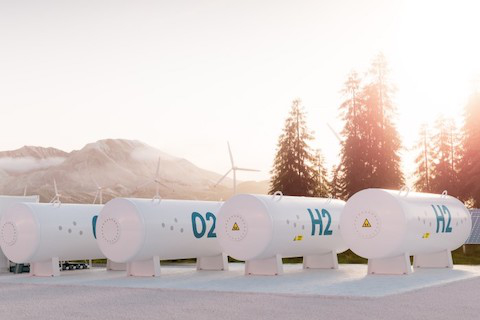
Hydrogen is one of the most intensively invested energy carriers of the European energy transition — but its physical and chemical properties make it one of the most demanding fluids to handle safely. High operating pressures, an extremely small molecule, and a flammability range in air far wider than most industrial gases: every component of a hydrogen plant must be selected against criteria that differ significantly from those used for conventional gases. Rupture discs are among the most critical passive safety devices in this context: they respond instantaneously to overpressure, without external power or control logic, protecting equipment from structural failure and releasing pressure in a controlled, predictable direction.
Takeaway
- Hydrogen service requires rupture discs manufactured from materials resistant to hydrogen embrittlement (HE): austenitic stainless steels such as 316L and aluminium are generally preferred over high-strength ferritic or martensitic steels.
- Hermetic sealing before activation is essential — the H₂ molecule is the smallest that exists and will permeate through any discontinuity, making leakage a concrete risk even before the device has opened.
- Key applications include electrolysers, high-pressure storage vessels, hydrogen refuelling stations, SMR and large-scale electrolysis production plants, and high-pressure distribution systems.
Why Hydrogen Creates Specific Challenges for Safety Devices
Working with hydrogen is not like working with other industrial gases, and that is not a matter of perception. The physical characteristics of H₂ create operating conditions that stress components and materials in ways that nitrogen, compressed air, or even natural gas do not. The first factor is the molecule itself: H₂ is the smallest that exists, with a molecular diameter of approximately 0.289 nm. This tiny size allows it to diffuse into the crystal lattice of metals at a rate far exceeding any other gas, gradually altering the mechanical properties of the material it contacts.
The second factor is pressure. PEM electrolysers of the latest generation produce hydrogen at pressures that in certain system configurations reach 350–700 bar, and onboard storage tanks for mobility applications can exceed 700 bar. In industrial process environments the ranges are often lower, but still significant. Designing a rupture disc for these conditions requires very tight activation tolerances and materials capable of maintaining their mechanical properties over time despite continuous exposure to high-pressure hydrogen.
The third factor is flammability: hydrogen burns across a concentration range in air of 4% to 75% by volume — far wider than natural gas (5–15%). Even a small leak therefore carries a significantly higher ignition probability. This makes hermetically sealed devices, which do not leak before activation and open in a defined direction when they do, a non-negotiable requirement rather than an optional upgrade.
Hydrogen Embrittlement: The Risk You Cannot See
Hydrogen embrittlement (HE) is arguably the least intuitive risk associated with using H₂ as a process fluid. It occurs when hydrogen atoms — small enough to diffuse into the metal lattice — accumulate at microstructural defects, grain boundaries, or zones of high stress concentration. Over time (and in some cases relatively quickly), this accumulation reduces the material’s ductility, increases its brittleness, and can initiate and propagate cracks even in the absence of elevated external loads.
Not all metals are equally susceptible. High-strength ferritic and martensitic steels, with a body-centred cubic (BCC) crystal structure, allow rapid hydrogen diffusion and are highly susceptible to HE. Austenitic stainless steels (such as 304 and 316L), with a face-centred cubic (FCC) structure, show significantly better resistance: the FCC lattice traps hydrogen atoms more effectively and slows their diffusion toward critical zones. Standard aluminium alloys are substantially immune to HE, making them an attractive choice for certain applications. Titanium, despite its lightness and corrosion resistance, is susceptible to HE through the formation of brittle hydrides and must be used with care in high-pressure hydrogen service.
For rupture discs in hydrogen service, material selection is therefore not a secondary variable — it is a primary design criterion. A disc manufactured from a susceptible material may embrittle over time, shifting the activation pressure, developing microcracks that are not detectable by visual inspection, or — in the worst case — failing in an uncontrolled manner before the rated burst pressure is reached.
Technical Requirements for Rupture Discs in Hydrogen Service
Suitable Materials and Compatibility
As outlined above, austenitic stainless steels in the 300 series — particularly 316L, with its low carbon content for improved resistance to intergranular corrosion — are the most widely used material for rupture discs in hydrogen service. Aluminium is used for applications at relatively lower pressures or where component weight is a relevant factor. In both cases, it is good practice to request documentation from the manufacturer on H₂ compatibility testing performed on the materials used, particularly for high-pressure or high-temperature applications.
Hermetic Sealing Before Activation
A rupture disc that leaks, even minimally, before reaching its burst pressure is an unacceptable risk in a hydrogen plant. Hydrogen leaks are not always visible, and can accumulate in confined areas to form explosive mixtures before they are detected. For this reason, discs for H₂ service are frequently supplied as sealed units, with an additional gasket or membrane that guarantees complete sealing toward the outside until the moment of opening. This is a constructive detail that might be considered optional for other fluids, but becomes a firm design requirement for hydrogen.
Activation Tolerance and Long-Term Stability
The burst pressure (p_stat) of a disc must remain stable over time, despite continuous contact with hydrogen at operating pressure. This requires a controlled manufacturing process and experimental verification that the chosen material does not undergo significant drift in mechanical properties under H₂ service conditions. Qualified manufacturers for this type of application document the tests performed and provide certificates stating the guaranteed activation tolerance, typically expressed as a percentage of the nominal burst pressure.
Key Applications in Hydrogen Systems
Hydrogen plants consist of multiple sections, each with specific pressure, temperature, and risk characteristics — and each potentially requiring different safety device specifications.
In electrolysers (both PEM and alkaline), rupture discs protect cells and gas collectors from abnormal pressure spikes that can originate from internal faults, system blockages, or pressure regulation failures. Operating pressures vary by system type and degree of integrated compression: in newer PEM systems, hydrogen can exit the electrolyser at pressures exceeding 30–50 bar.
In high-pressure storage vessels, rupture discs provide a last-resort protection against failure by overpressure: they are installed in parallel or in series with safety valves, depending on the application criticality and regulatory requirements. In certain designs, the disc is placed upstream of the valve to protect it from hydrogen permeation that could compromise the valve’s sealing integrity over its service life.
In hydrogen refuelling stations and distribution systems, rupture discs are present on compressors, heat exchangers, and high-pressure lines, where pressure transients can be fast and of significant magnitude.
In hydrogen production plants (natural gas reforming, large-scale electrolysis, biomass-derived hydrogen), rupture discs protect reactors, separators, and purification systems, often in combination with explosion venting panels for overpressure management in ATEX-classified explosion-risk areas. For plants in the energy sector requiring integrated solutions, the DonadonSDD team can provide technical support from the earliest design stages.
Selection and Customisation: Why Off-the-Shelf Discs Are Often Not Enough
For standard applications with common fluids, it is often possible to select a rupture disc from a catalogue, choosing nominal pressure, diameter, and material from available options. For hydrogen service, this approach is rarely adequate. Operating conditions frequently push against the boundaries of standard specifications, sealing requirements are more stringent, and the technical documentation demanded by hydrogen plant safety regulations (which are evolving rapidly at both European and international level) imposes certifications and traceability that not every catalogue device can provide.
Customisation encompasses not only the burst pressure and diameter: it includes material selection based on the specific service temperature and pressure, rupture geometry design to ensure complete and controlled opening, sealing type selection, compatibility of accessory components (holders, gaskets) with hydrogen, and full device technical documentation. DonadonSDD designs and manufactures fully custom rupture discs for hydrogen plants, with integrable rupture indicators for immediate activation monitoring. For technical consultation, contact the DonadonSDD team.
FAQ
It depends on the operating conditions. 316L is generally an excellent starting point for hydrogen embrittlement resistance, but its suitability must be assessed against the maximum operating pressure, temperature, and expected service duration. For high-pressure applications or systems with frequent thermal cycling, it may be necessary to verify the long-term stability of mechanical properties experimentally and to specify construction configurations designed for H₂ service.
Regulations specific to hydrogen plants are evolving rapidly. Depending on the country and plant type, applicable standards may include ISO/TR 15916 (Basic considerations for the safety of hydrogen systems), ASME B31.12 (Hydrogen Piping and Pipelines), or emerging European regulations covering electrolysers and refuelling stations. Engaging the disc manufacturer during the design phase is important to ensure the device meets the required documentation and certification requirements.
The disc-plus-valve series configuration is an established practice in applications where the process fluid can compromise valve sealing integrity over time. With hydrogen, permeation through valve gaskets is a real risk: the disc, placed upstream, shields the valve from direct hydrogen exposure during service, preserving its integrity and functionality for when it is actually needed. The disc responds first to rapid overpressure events, while the valve handles slower events or controlled venting conditions.